
If you’ve been putting off doing something about that sagging, faded, or stained sofa in your living room, you’re not alone. We get calls almost every week from people across Dubai — Jumeirah, Al Barsha, Business Bay, Mirdif — who’ve been living with a sofa they’re embarrassed to have guests sit on, simply because they weren’t sure whether upholstery was even worth it compared to buying new. So let’s actually walk through what happens, what it costs, and what surprises people the most.
Why Sofas in Dubai Wear Out Faster Than You’d Expect
This is something we tell almost every customer, and most people are genuinely surprised by it. Dubai’s climate is hard on furniture in ways people don’t think about. The AC runs constantly, which dries out foam and glue faster than in more temperate climates. Direct sunlight through floor-to-ceiling windows — which half the apartments here have — fades fabric within a couple of years if the sofa sits anywhere near a window. And dust gets into everything, working its way into the weave of the fabric and the padding underneath.
So a sofa that might last 8-10 years in a cooler, less sunny climate often starts showing real wear here by year 4 or 5. That’s not a defect in your furniture — it’s just Dubai.
What We Actually Check Before Quoting Anything
A lot of upholsterers will glance at a sofa and give you a number on the spot. We don’t do that, and honestly, we’d encourage you to be wary of anyone who does. Here’s what actually needs checking:
The frame. This is the part people forget about entirely. If the wooden frame underneath has cracked joints or the corner blocks have come loose (which happens a lot with sofas that get moved during villa renovations or apartment moves), reupholstering over a weak frame is a waste of money. We check every joint before quoting.
The foam and padding. Foam degrades over time — it goes from supportive to crumbly, and you can usually tell just by pressing down on the cushions and feeling whether they bounce back or stay compressed. If the foam has gone, it needs replacing regardless of what happens with the fabric.
The springs (if it’s a sprung sofa). Older sofas, especially ones bought 10+ years ago from certain Dubai furniture retailers, use coil springs rather than webbing. These can sag or snap, and it changes how the sofa sits.
Only after checking all three of these do we actually talk fabric and pricing — because the fabric is honestly the easiest part of the whole job.
Choosing Fabric: What Actually Holds Up Here
This is where most people spend the most time deciding, and understandably so — it changes the whole look of the piece. A few honest notes from years of doing this in Dubai specifically:
- Velvet looks incredible and is very popular right now, but if your sofa sits in direct sun for part of the day, go with a solution-dyed or UV-resistant velvet. Regular velvet will fade unevenly within a year or two of sun exposure.
- Linen-blend fabrics breathe well, which matters more here than people expect — a fabric that traps heat is genuinely uncomfortable to sit on for long stretches in summer, even with the AC on.
- Leather and faux leather are low-maintenance and wipe clean easily, which a lot of families with young kids or pets prefer, but real leather can feel warm to sit on directly under AC vents — something worth testing in-store before committing.
- Performance/outdoor-grade fabrics have gotten a lot better in the last few years and are worth considering even for indoor sofas if you have kids, pets, or just want something that’s genuinely stain-resistant rather than “stain-resistant” in name only.
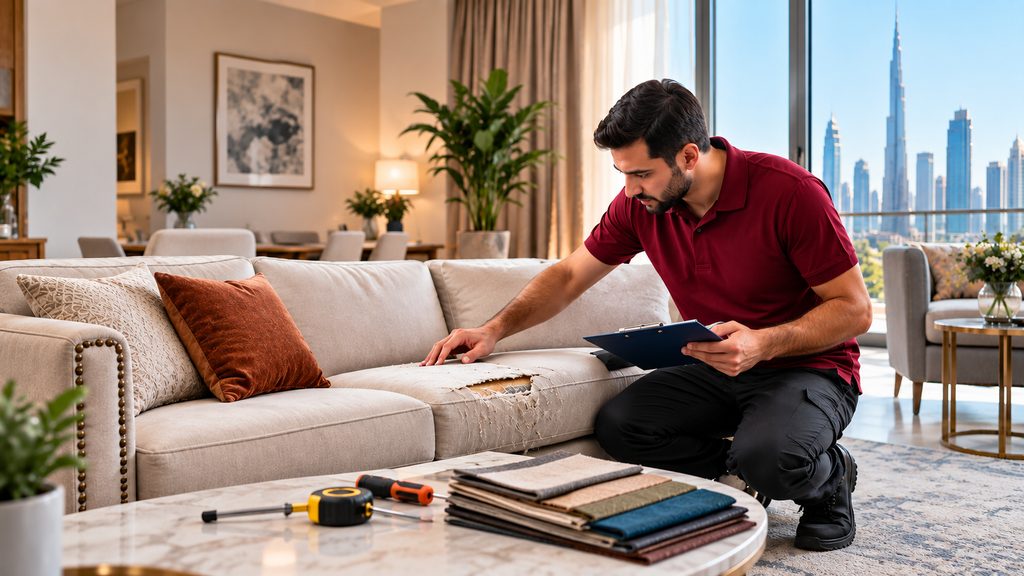
We usually bring physical swatches to the home rather than just showing catalog photos, because fabric color reads completely differently under Dubai’s natural light versus indoor lighting — a beige that looks warm in a shop can look almost grey once it’s in your living room.
How Long It Actually Takes
Be wary of anyone promising same-day turnaround on a full reupholstery — it’s not realistic for quality work. Realistically:
- A single armchair: 3-5 working days
- A standard 3-seater sofa: 5-7 working days
- A large L-shaped or sectional sofa: 7-10 working days
Simple repairs — a torn seam, a loose leg, replacing a single cushion cover — can often be done in a day or two, sometimes even on-site depending on the issue.
What It Costs
Pricing genuinely depends on the size of the piece, the fabric you choose, and whether foam or springs need replacing alongside the fabric. As a rough starting point for budgeting purposes: a straightforward single-seat armchair reupholstery tends to start in the low hundreds of dirhams for fabric and labor combined, while a full 3-seater with new foam typically runs into the low-to-mid thousands depending on fabric grade. Anything beyond that — L-shaped sectionals, sofas needing frame repair, premium fabrics like genuine leather — gets quoted individually because there’s too much variation to give a fair number without seeing it.
We’d always recommend getting an in-home assessment before comparing quotes, because a quote given without seeing the actual frame and foam condition isn’t really comparable to one that accounts for it.
A Few Things People Ask Us Often
Is it cheaper to reupholster than buy new? Usually, yes — especially for well-made sofas with solid hardwood frames. The frame and craftsmanship are often the most expensive part of a good sofa, and if that part is still solid, you’re really only paying to renew the outer layer. Cheaper flat-pack sofas with particleboard frames are sometimes not worth reupholstering, and we’ll tell you honestly if that’s the case rather than take the job anyway.
Can you match the exact original color? Not always exactly, but close. Fabric mills discontinue colors and dye lots vary, so if you’re only replacing part of a sofa (say, one cushion cover) and want it to match the rest, there can be a slight difference. We’ll always flag this upfront rather than let you find out after the fact.
Do you work on antique or inherited furniture? Yes, and honestly these are some of our favorite jobs. Older solid-wood frames are often better built than what’s sold new today, and there’s something satisfying about bringing a piece like that back to life rather than sending it to landfill.
Getting Started
If your sofa is somewhere between “needs a refresh” and “honestly falling apart,” it’s worth getting it looked at before deciding whether to repair or replace. We do in-home assessments across Dubai and can usually give you an honest read on whether the piece is worth saving within a few minutes of looking at the frame.
Get in touch for a free assessment, and we’ll tell you straight — no upselling, no pushing you toward the most expensive fabric on the shelf.